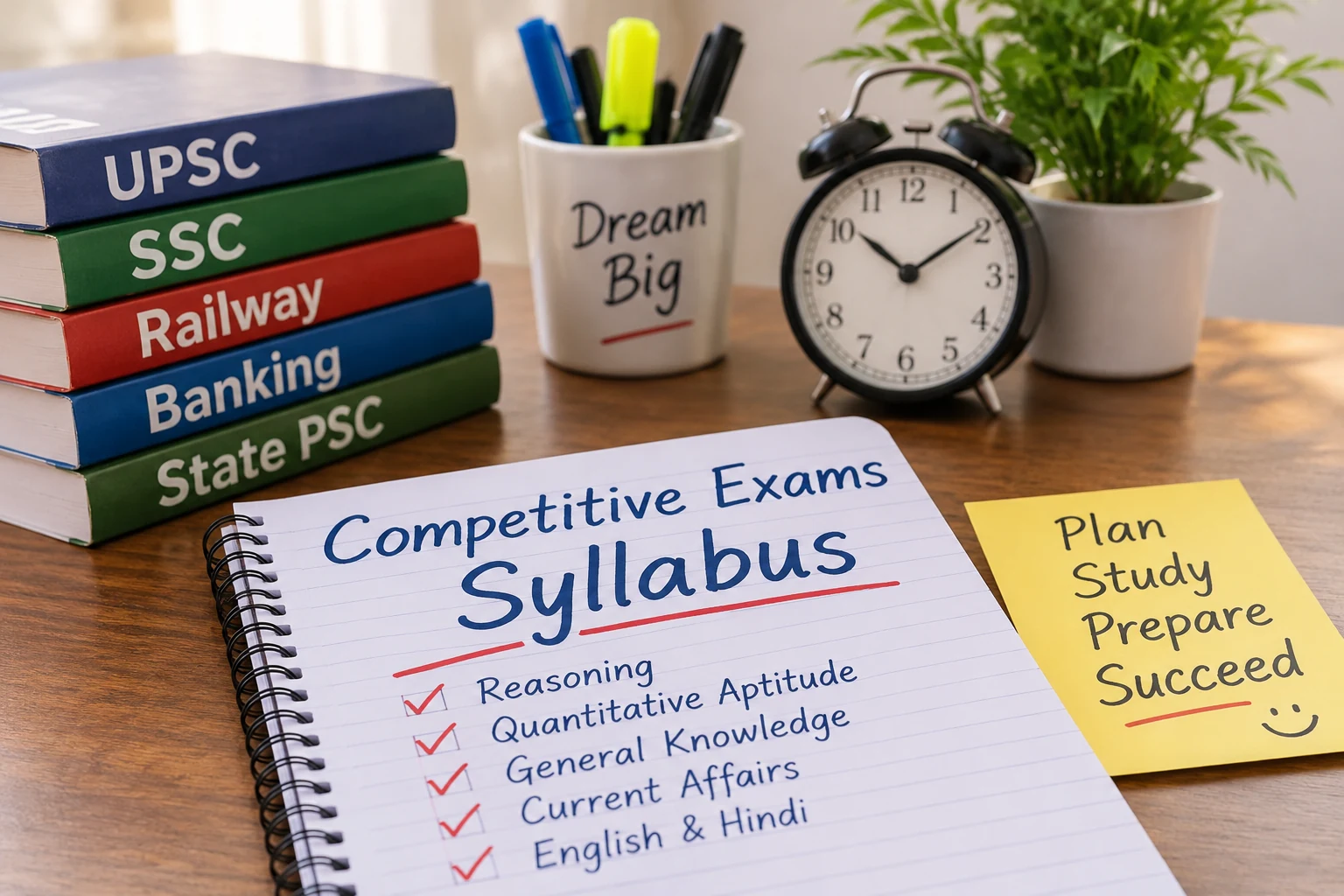
Master Syllabus for Competitive Exams in India: Subject-Wise Topic List
Most people start exam preparation with the same question: what exactly do I need to study? Before you buy books or join a coaching class, it helps to know which subjects keep showing up across exams and how they fit together.
If you’re aiming for SSC, UPSC, Railways, Banking, a state government job, Defence or a teaching exam, you’ll notice a lot of overlap. Reasoning, Maths, English, General Science, General Knowledge and Current Affairs appear in exam after exam. The difficulty and depth change, but the core subjects are familiar.
So we’ve put everything in one place. This page covers the major subjects and the topics that come up most often, so you don’t have to hunt through ten different sites.
One thing to keep in mind: this is a general master list, not the official syllabus of any specific exam. Every exam board sets its own requirements, so check what you read here against the latest official notification for your exam.
1. General Intelligence and Reasoning
Reasoning tests how well you spot patterns, connect ideas and reach a sensible conclusion under time pressure. You can’t memorize your way through it. The people who do well are the ones who practise a lot, and speed comes with that practice.
Verbal Reasoning
Analogy, Classification (Odd One Out), Number Series, Alphabet Series, Alphanumeric Series, Coding-Decoding, Blood Relations, Direction and Distance, Ranking and Order, Alphabet Test, Dictionary Order, Word Formation, Mathematical Operations, Venn Diagrams, Syllogism, Statement and Conclusion, Statement and Assumption, Statement and Argument, Cause and Effect, Decision Making, Problem Solving, Seating Arrangement, Puzzles, Data Sufficiency, Inequalities, Input-Output, Critical Thinking.
Non-Verbal Reasoning
Figure Classification, Figure Series, Figure Analogy, Mirror Images, Water Images, Paper Folding, Paper Cutting, Embedded Figures, Figure Completion, Pattern Completion, Counting of Figures, Cube and Dice, Spatial Visualization, Spatial Orientation, Rotation of Figures, Visual Memory.
2. Quantitative Aptitude and Mathematics
Depending on the exam, maths can mean simple arithmetic or fairly advanced concepts. If you’re starting out, get comfortable with basic calculation first. Everything else builds on it.
A. Basic Arithmetic
Number System, Natural Numbers, Whole Numbers, Integers, Rational and Irrational Numbers, Prime and Composite Numbers, Divisibility Rules, HCF and LCM, Simplification, BODMAS, Fractions and Decimals, Squares and Square Roots, Cubes and Cube Roots, Surds and Indices.
B. Arithmetic
Percentage, Ratio and Proportion, Average, Profit and Loss, Discount, Simple Interest, Compound Interest, Partnership, Mixture and Alligation, Problems on Ages, Time and Work, Pipes and Cisterns, Time-Speed-Distance, Problems on Trains, Boats and Streams, Work and Wages.
C. Algebra
Algebraic Expressions, Algebraic Identities, Linear Equations, Quadratic Equations, Polynomials, Algebraic Operations, Simplification of Algebraic Expressions, Equations and Inequalities.
D. Geometry
Basic Geometrical Concepts, Lines and Angles, Triangles, Congruence of Triangles, Similarity of Triangles, Quadrilaterals, Polygons, Circles, Chords and Tangents, Coordinate Geometry, Geometrical Theorems.
E. Mensuration
Perimeter and Area, Area of Triangles, Quadrilaterals and Circles, Surface Area and Volume, Cube and Cuboid, Cylinder, Cone, Sphere and Hemisphere, Prism and Pyramid.
F. Trigonometry
Basic Trigonometric Ratios, Identities, Standard Values, Complementary Angles, Heights and Distances, Applications of Trigonometry.
G. Data Interpretation and Statistics
Tables, Bar Graphs, Line Graphs, Pie Charts, Caselet-Based DI, Data Comparison, Mean, Median and Mode, Range, Basic Probability, Permutation and Combination.
3. General Knowledge and General Studies
This is the widest section. It covers India and the world: history, geography, how the government works, the economy and basic science. How deep you need to go depends entirely on your exam. A UPSC aspirant needs far more detail than someone sitting a clerical exam, but the topic list below is a good starting map.
A. Indian History
History is usually split into three parts.
Ancient: Indus Valley Civilization, Vedic Period, Buddhism and Jainism, Mahajanapadas, Maurya Empire, Gupta Empire, Post-Gupta Period, Ancient Indian Culture and Literature.
Medieval: Delhi Sultanate, Mughal Empire, Maratha Empire, Important Medieval Kingdoms, Bhakti and Sufi Movements, Medieval Art and Architecture.
Modern: Arrival of Europeans, British Rule in India, Revolt of 1857, Social and Religious Reform Movements, Indian National Congress, the National Movement and Freedom Struggle, Important Freedom Fighters, Governor-Generals and Viceroys, Key Historical Events.
B. Indian Geography
Location and Extent of India, Physical Geography, States and Union Territories, Mountains and Hills, Rivers and River Systems, Lakes and Waterfalls, Plateaus and Plains, Deserts, Climate and Monsoon, Soil Types, Agriculture, Irrigation, Minerals and Natural Resources, Industries, Transport, National Parks and Wildlife Sanctuaries, Biosphere Reserves, Population and Census, Neighbouring Countries.
C. World Geography
Continents and Oceans, Countries, Capitals and Currencies, Major Rivers, Mountains and Plateaus, Deserts and Grasslands, Climate and Weather, Natural Resources, Straits and Canals, Lakes, Important Geographical Locations.
D. Indian Polity and Constitution
Polity explains how the country actually runs: how the Constitution works and what each institution is responsible for. It’s a scoring subject once the basics click.
Historical Background and Making of the Constitution, Preamble, Salient Features, Fundamental Rights, Fundamental Duties, Directive Principles of State Policy, Union Government, President and Vice-President, Prime Minister and Council of Ministers, Parliament, Supreme Court, High Courts, State Government, Governor and Chief Minister, State Legislature, Panchayati Raj, Municipalities, Constitutional Amendments, Constitutional Bodies, Election Commission, CAG, UPSC and State Public Service Commissions, Emergency Provisions, Important Articles and Schedules.
E. Indian Economy
You don’t need to be an economist, but you should understand how the economy works, what institutions like the RBI do and how government policy affects ordinary people.
Basic Economic Concepts, Economic Planning in India, National Income, GDP and GNP, Inflation and Deflation, Poverty and Unemployment, Banking System, RBI, Monetary Policy, Fiscal Policy, Union Budget and Economic Survey, Taxation, Direct and Indirect Taxes, GST, Financial Inclusion, Agriculture and Industry, Government Economic Schemes, Balance of Payments, Foreign Trade, Important Economic Institutions.
F. General Science
Science questions usually test basics and everyday applications, not heavy theory.
Physics: Units and Measurements, Motion, Force and Laws of Motion, Work, Energy and Power, Gravitation, Pressure, Heat and Temperature, Sound, Light, Reflection and Refraction, Electricity, Magnetism, Modern Physics, Scientific Instruments.
Chemistry: Matter and Its States, Elements, Compounds and Mixtures, Atoms and Molecules, Atomic Structure, Periodic Table, Chemical Reactions, Acids, Bases and Salts, Metals and Non-Metals, Carbon and Its Compounds, Fuels, Everyday Chemistry, Important Chemical Compounds.
Biology: Cell Structure and Functions, Human Body Systems (digestive, respiratory, circulatory, nervous, excretory, reproductive), Vitamins and Minerals, Diseases and Prevention, Nutrition, Genetics, Plant Physiology, Human Physiology, Ecology and Environment, Microorganisms.
G. Environment and Ecology
Ecosystem, Biodiversity, Food Chain and Food Web, Natural Resources, Pollution, Climate Change, Global Warming, Greenhouse Effect, Ozone Layer, Wildlife Conservation, Environmental Protection, National Parks, Wildlife Sanctuaries, Important Environmental Conventions.
H. Static GK
Static GK is the set of facts that rarely change, which makes it a favourite for objective-type questions.
Important Days and Dates, National Symbols, Countries, Capitals and Currencies, Important Organizations and Their Headquarters, Books and Authors, Awards and Honours, Sports and Trophies, Famous Personalities, Historical Places, Monuments and Architecture, Folk and Classical Dances, Music and Musical Instruments, Festivals, Languages of India, Firsts in India and the World, Discoveries and Inventions.
4. Current Affairs
Almost every competitive exam has current affairs questions. Reading headlines isn’t enough. Try to understand why an event happened and why it matters, because that’s what makes it easier to remember.
National: National News and Events, Government Policies and Decisions, Schemes, Appointments, Awards and Honours, Summits and Conferences, Bills and Acts, Reports and Rankings, Committees, Important Supreme Court Judgments, Infrastructure Developments, Science and Technology.
International: International News and Relations, Summits, Global Organizations, Agreements and Treaties, Global Reports and Rankings, International Appointments, Countries in the News, Conflicts and Developments.
Economy and Banking: RBI Announcements, Monetary Policy Updates, Banking News, Budget Updates, Economic Survey, Inflation and GDP Updates, Financial Schemes, Mergers and Acquisitions, Business News, Financial Reports.
Sports: National and International Events, Major Tournaments, Winners and Runners-up, Sports Awards, Records, Important Players, Venues, Olympics, Asian Games, Commonwealth Games, World Championships.
Science and Technology: Space Missions, ISRO, Defence Technology, Artificial Intelligence, Scientific Discoveries, New Technologies, Research Developments, Defence Exercises, Missiles and Satellites.
Other: Obituaries, Books and Authors, Important Days and Themes, Awards, Government Appointments, Brand Ambassadors, MoUs, Indexes and Reports.
5. English Language
English papers check your grammar, vocabulary and reading ability. Some exams stick to basic grammar and word knowledge. Others add long comprehension passages and tougher language questions.
Grammar: Parts of Speech (Noun, Pronoun, Verb, Adjective, Adverb, Preposition, Conjunction), Articles, Tenses, Subject-Verb Agreement, Active and Passive Voice, Direct and Indirect Speech, Modals, Conditional Sentences, Sentence Structure, Question Tags, Degrees of Comparison.
Vocabulary: Synonyms, Antonyms, One Word Substitution, Idioms and Phrases, Phrasal Verbs, Homonyms and Homophones, Spelling Correction, Word Usage, Commonly Confused Words.
Verbal Ability: Error Detection, Sentence Improvement and Correction, Fill in the Blanks, Cloze Test, Reading Comprehension, Para Jumbles, Sentence Rearrangement, Sentence and Paragraph Completion, Word Replacement.
6. Hindi Language
Hindi is a scoring section in many state-level and other exams. Questions usually cover grammar, vocabulary, sentence formation and comprehension.
हिंदी व्याकरण: वर्णमाला, स्वर और व्यंजन, संज्ञा, सर्वनाम, विशेषण, क्रिया, क्रिया विशेषण, लिंग, वचन, कारक, काल, वाच्य, संधि, समास, उपसर्ग, प्रत्यय, पर्यायवाची शब्द, विलोम शब्द, अनेकार्थी शब्द, तत्सम और तद्भव, देशज और विदेशी शब्द, मुहावरे और लोकोक्तियाँ, वाक्य शुद्धि, शब्द शुद्धि, वाक्य रचना।
हिंदी भाषा कौशल: अपठित गद्यांश, रिक्त स्थान पूर्ति, वाक्य परिवर्तन, वाक्य क्रम व्यवस्था, गद्यांश आधारित प्रश्न, शब्द प्रयोग, अशुद्धि पहचान, वाक्य सुधार।
7. Computer Awareness
You’ll find this in banking, clerical, administrative and several other recruitment exams. It covers the basics of how computers work, common software, the internet and digital technology.
Introduction to Computers, History and Generations, Types of Computers, Hardware, Software, Input and Output Devices, CPU, Memory and Storage, Operating Systems, Windows Basics, MS Word, MS Excel, MS PowerPoint, Networking, Internet and Intranet, Web Browsers, Search Engines, E-mail, Keyboard Shortcuts, Database Management, Computer Languages, Programming Basics, Cybersecurity, Viruses and Malware, Digital Payments, Digital Banking, Cloud Computing, AI Basics, Information Technology.
8. Banking and Financial Awareness
If you’re preparing for a bank exam, give this section extra time. It covers how the banking system works, the institutions involved and the financial terms you’re expected to know.
Banking in India and Its History, RBI and Its Functions, Types of Banks (Commercial, Cooperative, Regional Rural, Payment and Small Finance Banks), Types of Bank Accounts, Deposits and Loans, Banking Instruments, Cheques and Demand Drafts, NEFT, RTGS and IMPS, UPI and Digital Payments, Monetary Policy, Repo and Reverse Repo Rate, CRR and SLR, NPAs, Financial Inclusion, Priority Sector Lending, Banking Regulations, Insurance Awareness, Financial, Capital and Money Markets, SEBI and Other Financial Institutions, Financial Terms and Abbreviations, Important Banking Schemes.
9. Scientific Developments and Everyday Science
Beyond textbook Physics, Chemistry and Biology, some exams ask about inventions, discoveries and how science shows up in daily life.
Everyday Science, Scientific Principles and Instruments, Inventions and Discoveries, Scientists and Their Contributions, Space Science, Biotechnology Basics, Nuclear Science, Information and Communication Technology, Recent Scientific Developments, Applications of Science in Daily Life.
10. General Knowledge of India
This section is about India’s culture, heritage, institutions and places.
Indian Culture and Heritage, Art and Architecture, Classical and Folk Music, Classical and Folk Dance, Festivals and Fairs, Literature, Languages, Historical Monuments, Temples and Cultural Places, States and Their Specialities, Famous Personalities, Important Institutions, National Parks and Wildlife Sanctuaries, Government Organisations, National Projects, Indian Firsts, Defence Organisations, Cultural Sites.
11. General Mental Ability and Analytical Aptitude
Some exams want to see how you analyse information and make decisions, not just whether you remember facts.
Logical and Analytical Reasoning, Critical Reasoning, Decision Making, Problem-Solving, Situational Judgement, Data Analysis and Interpretation, Data Sufficiency, Mathematical Reasoning, Deductive and Inductive Reasoning, Argument Evaluation, Statement-Based Reasoning, Logical Relationships.
12. Language and Communication Skills
Some exams go beyond grammar and vocabulary and check whether you can read, write and express yourself clearly.
Reading and Writing Skills, Grammar and Usage, Vocabulary Development, Reading Comprehension, Sentence Formation, Paragraph Writing, Essay Writing, Precis Writing, Letter Writing, Summary Writing, Translation, Communication Skills, Verbal Ability.
13. State-Specific General Knowledge
For a State Public Service Commission exam or another state-level recruitment, your own state’s history, geography, culture and current affairs matter a lot. A BPSC aspirant should know Bihar inside out, and someone preparing for UPPSC needs the same depth on Uttar Pradesh.
History and Geography of the State, Rivers and Lakes, Climate and Natural Resources, State Economy, Agriculture and Industries, State Government Structure and Administration, Government Schemes, State Budget, State Current Affairs, Famous Personalities, Art and Culture, Folk Dances and Music, Festivals and Fairs, Historical Monuments, Tourist Places, National Parks and Wildlife Sanctuaries, State Awards and Honours, Districts and Administrative Divisions.
14. Additional and Specialized Subjects
Some exams ask for knowledge of a particular profession or academic field. Depending on yours, you might need:
Child Development and Pedagogy, Educational Psychology, Teaching Methodology, Subject-Specific Maths and Science, Agriculture, Indian Law and Legal Awareness, Defence and Military Awareness, Engineering Mathematics, Civil, Mechanical and Electrical Engineering, Computer Science and IT, Statistics, Accountancy, Auditing, Business Studies, Sociology, Public Administration, Ethics and Integrity, Essay and Descriptive Writing.
Study these only if your exam asks for them.
How to Use This Master Syllabus
A long topic list can feel overwhelming. Here’s a simple way to make it useful.
1. Pick your exam first. SSC CGL, UPSC, RRB NTPC, IBPS PO, BPSC and NEET are very different from each other, so decide where you’re headed before you start.
2. Check the official notification. Read the latest syllabus from the exam authority and mark which topics from this page apply to you. Ignore the rest.
3. Break it into small chunks. Don’t try to cover everything at once. Finish one topic, then move to the next.
4. Practise as you go. After each topic, solve a set of MCQs. It’s the quickest way to find out whether you really understood it.
5. Solve previous-year papers. They show you the real question style, the difficulty level and which topics the examiners favour.
6. Revise often. Keep short notes of formulas, facts and the questions that tripped you up. Revision matters as much as learning new material.
7. Keep up with current affairs. Follow national and international news, especially the areas your exam focuses on.
8. Take mock tests. They teach you time management and show you where you’re weak while there’s still time to fix it.
Frequently Asked Questions
What is the Master Syllabus for Competitive Exams in India?
It’s a combined list of the subjects and topics that commonly appear across competitive exams in India, including Reasoning, Maths, GK, General Science, Current Affairs, English, Hindi and Computer Awareness.
Is the same syllabus used for every competitive exam?
No. Each exam has its own syllabus, pattern and subject requirements, though many subjects overlap.
Which subjects are common to most government exams?
General Awareness, Reasoning, Maths, English and Current Affairs show up in many of them, but the weightage differs from exam to exam.
Does this cover SSC, UPSC, Railway and Banking exams?
It gives you a broad overview of the subjects relevant to these exams. For the complete and accurate requirements, always refer to each exam’s own syllabus.
Do I need to study every subject here?
No. Choose the topics that match your target exam and follow its official syllabus.
How do I prepare using this syllabus?
Pick your exam, compare its official syllabus with this list, study the relevant topics, practise MCQs, solve previous-year papers and revise regularly.
Is this the official syllabus?
No. It’s a general educational reference. Check the latest syllabus and guidelines from the exam authority.
More Study Resources
You can find more material on PyqPDFDownload.com:
- Previous Year Question Papers (PYQs): Practise real questions from earlier exams and get used to the pattern.
- MCQs and Practice Questions: Topic-wise practice to build accuracy.
- Subject-Wise Study Materials: Concepts organized by subject.
- General Knowledge and Current Affairs: Stay on top of national and international developments.
- Exam-Wise Syllabus: The syllabus for your specific exam.
Final Words
Every exam needs its own strategy, but knowing what you have to study is always the right first step. Use this list to plan your preparation, decide where to spend your time and build a schedule you can actually stick to.
Aim to understand concepts instead of just memorizing them, and leave room for regular practice and revision. Learn from your mistakes, stay consistent, and take it one topic at a time.
Best of luck with your preparation!
Disclaimer: This article is for general educational and exam-preparation purposes. Syllabi, exam patterns and subject requirements can change by exam and by year. PyqPDFDownload.com offers an overview of commonly covered subjects and topics. Please verify the latest official syllabus and notifications from the relevant exam authority.